Sunday, March 3, 2013

Signs: A Window into the Infant Mind for Researchers Too


I spent last Tuesday with my twin, almost 4-year-old grandchildren—Nate and Olivia—because they were home sick from preschool. Both of them were great signers, so I decided to see if they remembered any of their signs. I mentioned that they used to use a sign for “more,” and Nathan quickly tapped his fists together, clearly remembering something from easily 18 months earlier. Then Olivia did the sign for “all done” and Nate asked me to remind him what the sign was for “drink.” Soon we were all into it with them remembering lots of signs—like book, bird, dog, and moon—and even a specific experience when they had used the bird sign to talk about a hawk out back. My conversation with them reminded me of one of my favorite signing stories where a 2-year-old little girl, who had switched from sign to words a whole year earlier, suddenly began to teach her doll the sign for “more!”

The doll story and my conversation with Nate and Olivia reminds me of one of the less obvious gifts signing with babies has given us. For a very long time, researchers (as well as parents) assumed that babies’ memory abilities were severely limited. And who was to tell us differently? After all, without words to share their thoughts, babies seem almost oblivious to the past and future. But now, with signs at their disposal, babies are sharing what they see, hear, feel, and even what they remember with both parents and researchers! Finally we’re getting proof that babies are a lot smarter than they look!

Let’s hear it for signing with babies!

Linda

Linda Acredolo, Ph.D.
Professor Emeritus, UC Davis
and
Co-Founder, The Baby Signs® Program

Sunday, February 24, 2013

“But We’re Not Laughing At You!”


This week I'm taking a detour from my usual topic of the Baby Signs Program to talk about a topic from Baby Hearts, the third parenting book I co-authored with Dr. Susan Goodwyn--the development of embarrassment.

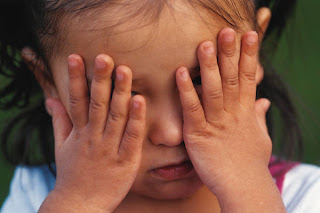
If there’s a 2-year-old at your next family get-together , it’s likely that at one time or another everyone will be laughing at something amusing she has done. Maybe she is busily eating chocolate cake, getting more around her mouth than in it, or maybe she is carefully trying to walk in her mother’s high heels. Whatever the behavior, as soon as the child becomes aware that she is the focus of attention she becomes upset. And no matter how many times she is reassured that no one is laughing at her, she remains inconsolable and is too embarrassed to continue.

Where does such embarrassment come from? Has some humiliation in the child’s past created an expectation of punishment or shame? Probably not. According to developmental researcher, Dr. Michael Lewis, such reactions are typical of children starting between 18 and 24 months. It’s at this age that children begin to experience embarrassment when they find they are the center of attention. It’s not that they think they’ve done anything wrong or shameful. It’s just that everyone is looking at them and it makes them extremely uneasy.

Why does such self-consciousness begin between 18 and 24 months? It’s quite simple. This is the age when toddlers first become aware of themselves as separate from other people, knowledge that is obviously critical to feeling embarrassed. In fact, Lewis demonstrated a direct connection between self-awareness and embarrassment in the following way.

First, he tested a group of toddlers to see if they could recognize themselves in a mirror – a classic test of self-awareness. The way to do this is to surreptitiously dab a spot of rouge on a child’s nose, set him in front of a mirror, and watch to see if he touches his nose. If he does, then it’s clear that he recognizes that the red spot on the nose in the mirror is a red spot on his own nose. Some the toddlers in Lewis study did touch their noses, while others did not.

Lewis then tested whether these same children would show embarrassment. He had their mothers urge them to dance in front of the experimenter to the sound of a tambourine. As you might expect, some children did so without hesitation while others refused, showing classic signs of embarrassment. Every one of these latter children, and very few of the former, were among those able to recognize themselves in a mirror, a lovely demonstration that the child’s developing mind and the child’s developing emotions are closely related.

Apparently the novelty of understanding that one is the center of attention is very unnerving. Whether or not there is a judgment involved is irrelevant; the child simply wants the attention itself to stop…now. The more mature understanding that one has done something that has violated some kind of standard of behavior won’t develop for another year or so. In the meantime, realizing that it’s the attention itself that toddlers dislike can help parents be more sympathetic. After all, would you want everyone watching you stuff chocolate cake into your mouth? I thought not.

Happy Signing (and don’t forget to follow us on Facebook)!

Linda

Linda Acredolo, Ph.D.
Co-Founder, the Baby Signs Program
and
Professor Emeritus, UC Davis

Monday, February 18, 2013

Potty Training: Emotional Readiness


Over the last month, I’ve been sharing the kinds of “readiness” that pediatricians argue is critical to potty training. Previous posts have dealt with physical and cognitive readiness. Today we’ll tackle the third and final: emotional readiness.

Emotional readiness for potty training means a willingness to cooperate. According to the American Academy of Pediatrics, the likelihood of such cooperation increases after the first birthday with the emergence of the following:

• A desire for independence and self-mastery
• An interest in imitating others
• A desire for approval

Once these fundamental characteristics in place, all that’s necessary is motivating children to cooperate. In other words, anything that increases the willingness of toddlers to embrace potty training automatically creates the emotional readiness that the AAP says is essential.

So, how does one help a 1- to 2-year-old get excited about potty training? Here at Baby Signs we’ve given that question a great deal of thought. Based on what we know about development, what we’ve experienced ourselves with our own children and grandchildren, and what we’ve heard from many parents, we’ve put together a set of materials designed to do just that—inspire even 1- to 2-year-olds to “climb on board the potty train.” They are all included in a kit entitled Potty Training Made Easy with the Baby Signs Program.

A highlight of these materials is our All Aboard the Potty Train DVD featuring our popular DiaperDoodle characters who slowly act out a typical “potty routine” that incorporates five helpful potty-time signs: POTTY, MORE, ALL DONE, WASH, and GOOD JOB. Additional motivational components include a lift-a-flap board book, conductor’s whistle and stickers.

To review: If children are physically and cognitively “ready” for potty training between ages 1 and 2 and can be inspired to cooperate using fun materials, why wait! Help reverse the diaper-industry-inspired trend toward later and later potty training by getting your child out of diapers by age 2. Your child, the environment, and your pocketbook will all thank you!

Happy Signing (and don’t forget to follow us on Facebook)!

Linda

Linda Acredolo, Ph.D.
Professor Emeritus, UC Davis
and
Co-Founder, The Baby Signs® Program